
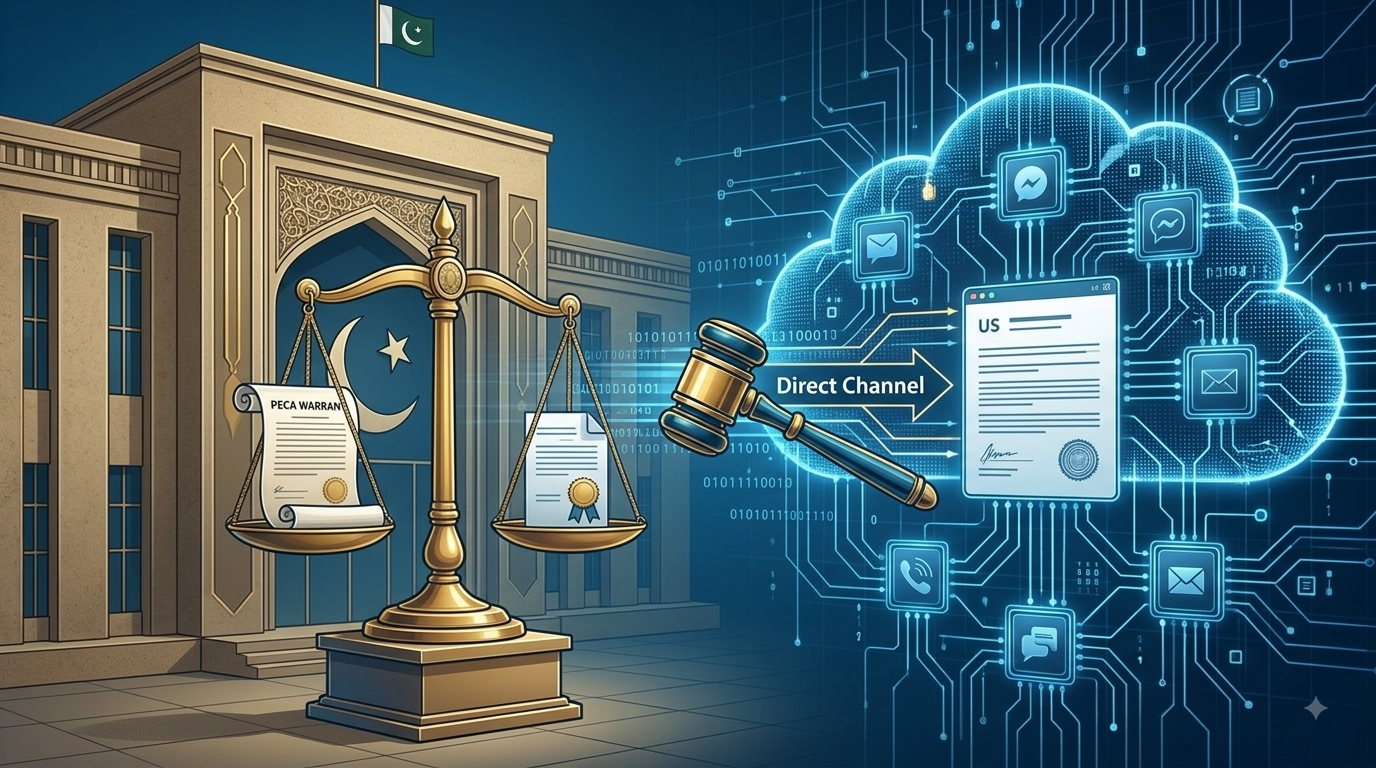
On July 23, 2026, Pakistan’s Federal Investigation Agency announced a direct communication channel with Meta’s Asia Pacific compliance team, built to speed up cybercrime investigations touching Facebook, Instagram, and WhatsApp. Before this, an FIA officer requesting data from Meta had one formal route: a Mutual Legal Assistance Treaty request, or an Interpol channel, a process officials say routinely took months. Now, one designated contact inside FIA’s new National Command and Control Centre, NC3, submits requests directly to Meta APAC.
Reported this way, it sounds like a clean efficiency fix. Read against the actual text of Pakistan’s cybercrime law and Meta’s own published policies, it opens two legal questions that no outlet covering the announcement has answered.
What Pakistani law actually requires before your data moves
The Prevention of Electronic Crimes Act does not treat every category of data the same way, and the differences are the whole story here. Traffic data, things like login IP history, falls under Section 32, and a service provider can only be compelled to produce it, in the Act’s own words, “subject to production of a warrant issued by the Court.” Content data, the actual substance of what you sent, needs a separate warrant under Section 34, issued only after a judge is shown reasonable grounds and records those reasons in writing. Real-time interception under Section 39 needs its own court order, capped at seven days. Preservation requests sit at the lightest end: an officer can issue one on written notice alone and has 24 hours to inform a court, after the fact rather than before. Basic subscriber information, things like an account’s registration details, has no dedicated warrant provision anywhere in the Act at all.
Compare that against what FIA’s new channel actually lists as the request categories it handles: preservation, basic subscriber information, account registration details, login IP history, content removal, and emergency disclosure.
One distinction here is easy to miss and changes the analysis considerably. Content removal is not the same legal act as content disclosure. Removal means asking Meta to take something down, governed by a much lighter provision, the Authority’s general power over unlawful online content. Disclosure means producing the actual message content as evidence in a case, the exact category Section 34 places behind a warrant. FIA’s own published list only mentions removal. Whether real content evidence, the category that actually matters in a prosecution, moves through this new channel at all is not stated anywhere in the public record.
That leaves an open question sitting in plain sight. The FIA has described case files as needing “required legal documents” before reaching NC3. Whether that phrase means an actual Section 32 or Section 34 court warrant, or an internal approval that never involves a judge, is not something the government has clarified, and not something any of the four outlets that covered this story asked.
The second legal system nobody’s checking
Even a fully warrant-compliant Pakistani request runs into a separate legal system on the other end. Meta’s own Law Enforcement Guidelines confirm that Meta Platforms, Inc., the US entity, handles accounts for users outside Europe, which includes Pakistani users. Its disclosures are governed by the US Stored Communications Act. Under that law, handing over actual content data to a foreign government still requires formal US legal process, typically, an MLAT request reviewed by a US court, unless the requesting country holds a CLOUD Act executive agreement with the United States that allows it to bypass that step.
Only two countries currently have one: the United Kingdom and Australia. Pakistan is not among them.
A faster internal routing system on Pakistan’s side does not change what Meta is legally permitted to hand over from the American side. For the category that matters most in an actual prosecution, content evidence, Meta’s obligations under US law appear identical to what they were before this channel existed.
Why the government’s own justification doesn’t quite hold up
FIA’s Director General framed this new channel around the hardest cases: terrorism and child exploitation, investigations that depend on actual message content, not subscriber lookups or registration dates. It’s a compelling justification, and it’s also the framing least likely to invite scrutiny.
But content is precisely the category where nothing appears to have changed. If Meta’s obligations under US law stay fixed regardless of how a request physically arrives, the real speed gains from this channel most plausibly land on the lighter categories, preservation, subscriber lookups, takedown requests, rather than the specific cases the announcement was built around.
Where this leaves things
Two questions remain open, not one. Domestically: does the legal documentation behind an NC3 request include an actual PECA warrant, or something short of it. Internationally: for the cases that genuinely need content evidence, is FIA still routing through the older MLAT process behind the scenes, with this new channel absorbing everything else.
Neither has a public answer yet. Pakistan has a specific, court-supervised legal framework for compelling data from a service provider. The United States has a separate framework governing the company actually holding that data. A faster channel between two governments doesn’t remove either framework. It just makes it harder, from the outside, to tell which one is actually doing the work in any given case.
This analysis reflects CyberTalks’ own reading of PECA’s text and Meta’s published guidelines, not a confirmed account of FIA’s internal procedure. If you have direct knowledge of how these requests are processed, we’d like to hear from you.